
Disclaimer: We hold a long position in PSIX at the time of publication and may adjust our position at any time without notice. This article is for informational purposes only and does not constitute investment advice. All views expressed are the authors’ own and are based on publicly available information and fieldwork conducted by Maius Partners. We do not represent that the information is accurate or complete, and it should not be relied upon as such. Readers should conduct their own due diligence and consult with a qualified financial advisor before making any investment decision.
Background Introduction
In our previous note, “Return of the Power King” (link), we briefly highlighted one of China’s top long-term compounders: Weichai Power, which has generated more than 20% p.a. returns since its 2004 IPO.
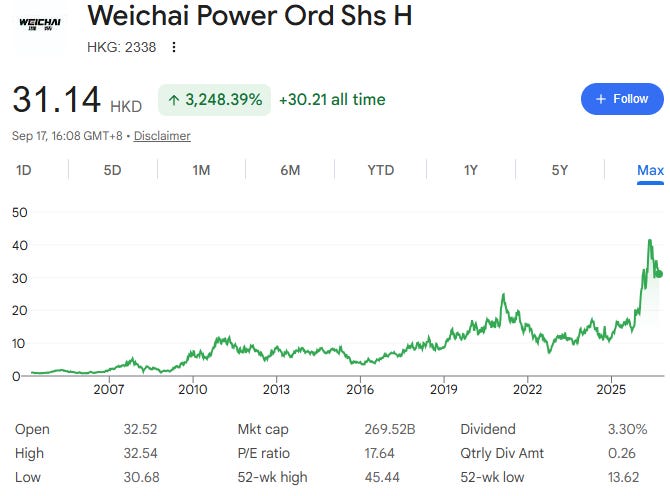
This article covers Weichai's history before discussing what we think is currently one of the best risk-adjusted opportunities across the wider Weichai ecosystem.
Part I: Turnaround (1998 - 2008)
When Tan Xuguang took the helm of Weichai in 1998, he inherited a state-owned enterprise on the verge of bankruptcy, with reportedly ¥80k cash against ¥300m debt.
What followed was a masterclass in ruthless turnaround execution, cutting unprofitable product lines and headcount, and focusing on doing one thing well: the construction machinery market. He focused heavily on R&D with what limited resources the company had, including sending 30 engineers to Austria to master the process and specifications for developing high-speed engines. 1
Flush with cash from its US$170m Hong Kong IPO in 2004, Weichai embarked on its most transformative acquisition: acquiring Torch Automobile Group, which owned critical transmission gear and axles technology, for ¥1.02bn cash in 2005 - the largest cash acquisition deal in China's capital markets at the time2- turning Weichai from an engine company to a Powertrain solutions provider.
Part II: International Expansion (2009 - Today)
By 2009, Weichai faced a critical ceiling: it had already dominated the domestic heavy-duty truck engine market, but it lacked the proprietary technology to compete in the “large-bore” engine segment—the massive engines required for power generators, mining trucks, and marine vessels. Unlike trucking engines, which are more susceptible to cycle volatility, the market for these large engines has historically been far more stable, given its high barriers to entry and oligopolistic structure, with CAT 0.00%↑ CMI 0.00%↑ and MTU dominating the bulk share of the market.
Enter Moteurs Baudouin, a century-old French marine engine manufacturer that had slipped into insolvency amid the 2008 global shipping collapse and was purchased for 2.99 million euros by Weichai.3 This video tells Boudouin's history from a French perspective.
In 2010, Chairman Tan proudly announced the 5810 Green Power Project, a roadmap to dethrone the global leader Cummins over the next decade: generate sales of 50 billion yuan in 2012, 80 billion yuan in 2015, and 100 billion yuan in 2020. Although Weichai’s group revenues are similar to Cummins today, Weichai is still much smaller valuation-wise.
Today, Baudouin engines are not just powering ships; they are capitalizing on the explosive global AI infrastructure boom, with massive gensets like the 4.2 MW Baudouin 20M55 serving as the backup power for hyperscale data centers worldwide. According to public consultation filings, the company is actively consulting on significantly expanding its production and testing facility to support engines up to 6MW4.
If Baudouin was about acquiring large-bore diesel engine technology, the 2017 investment in Power Solutions International PSIX 0.00%↑ was a dual-pronged master play in North American market access and alternative fuels technology.
At the time, the company was heavily leveraged to the oil and gas industry, which had collapsed following the shale boom. Further, following an internal accounting scandal and a plummeting stock price, PSI desperately needed a capital lifeline.
In March 2017, Weichai announced a $60m investment, eventually gaining 46% ownership. In April 2017, the company was ultimately delisted5 yet continued to trade OTC in the subsequent years. However, absent capital market support, Weichai provided a range of shareholder loans and bank guarantees to keep the business afloat during this turbulent period.
In December 2024, PSIX completed its uplisting on the Nasdaq Stock Market6.
The PSIX Setup
In an unpublished note that did not meet the quality-control standards of esteemed third-party research service providers (shown below for reference), we first identified the opportunity in PSIX in December 2024, shortly after its uplisting. However, by August 2025, the stock had already more than tripled, thereby making us more cautious in our update note (link).
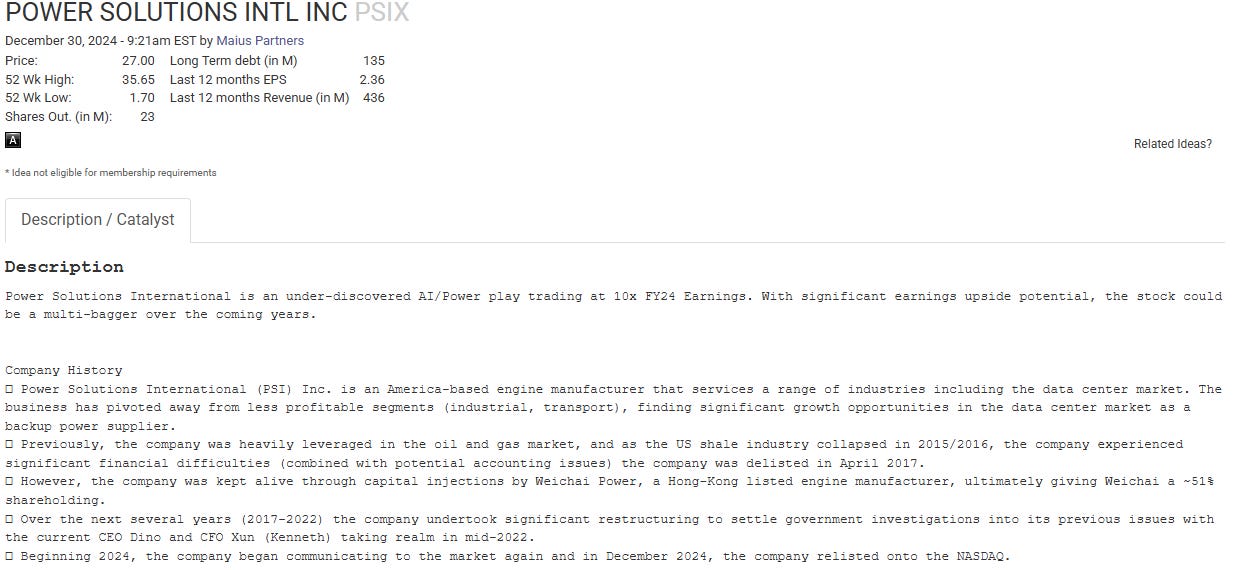
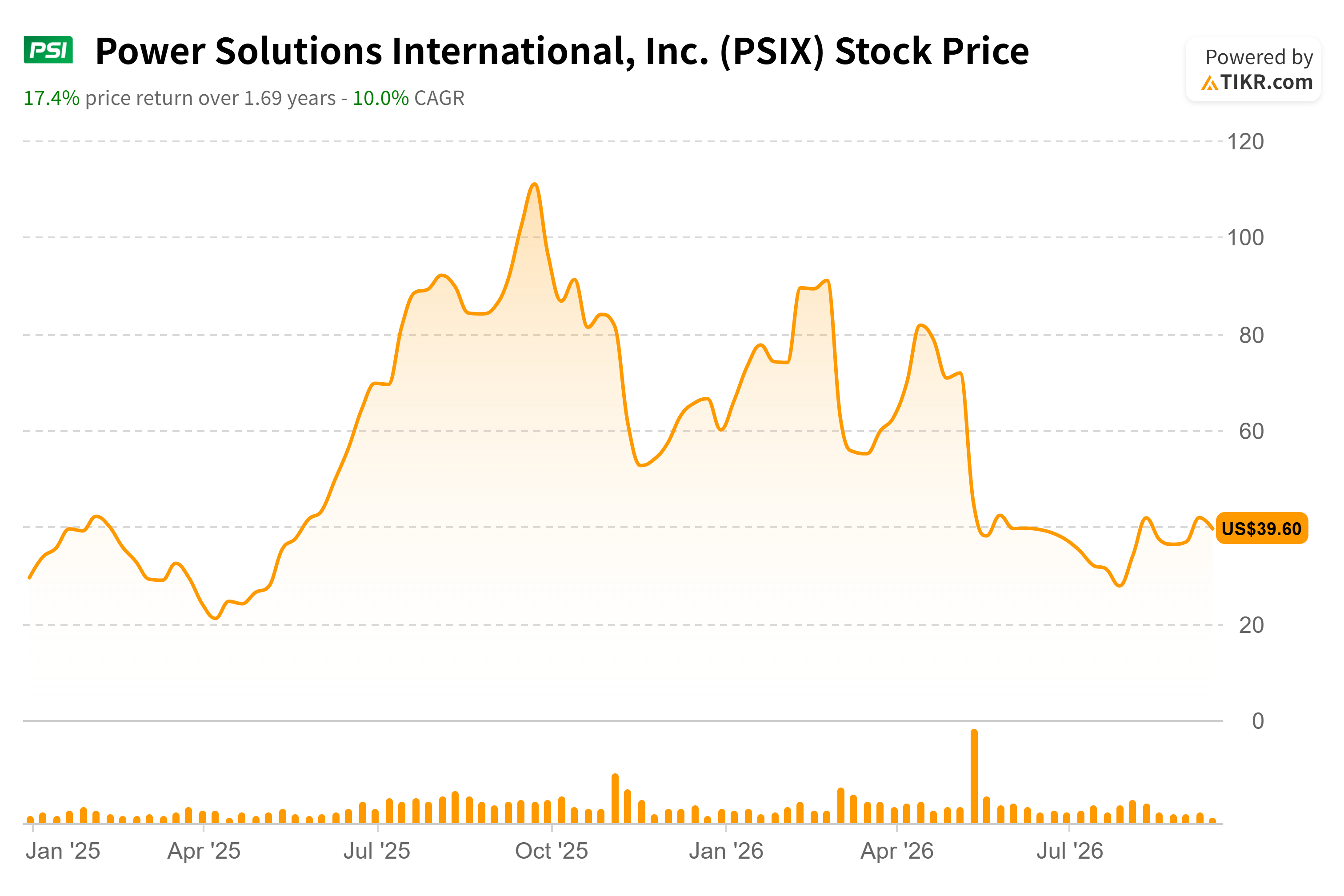
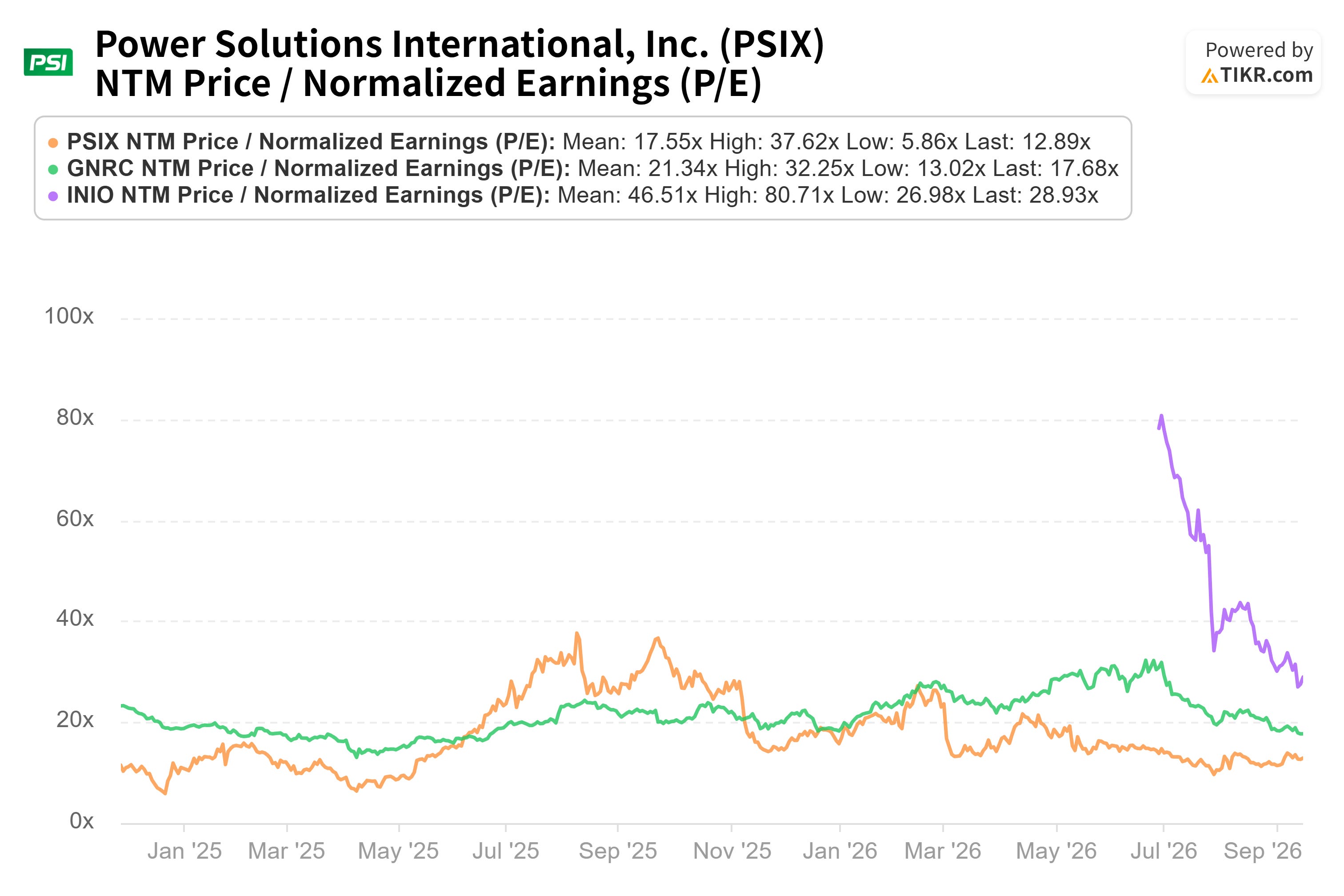
With the stock now down roughly 2/3 from its September 2025 peak, and trading once again near 10x earnings, we believe the risk/reward has never been better than since its uplisting.
Company Overview
PSIX’s historical business was focused on servicing the oil and gas market; however, following the sector’s decline post-2015, it increasingly turned its attention to the industrial and transport markets, with a particular niche focus on both manufacturing (smaller) and purchasing (larger) diesel engines from OEM’s, converting and selling those engines to run on multiple alternative fuel types.
As expected, given the strong bargaining power of its engine suppliers (e.g., General Motors) and its end customers (e.g., John Deere), this was a low-margin niche business, consistently earning mid-teens-type gross margins.
However, beginning in 2024, the business began experiencing rapid growth in its power systems business division, a trend echoed by Cummins in its May 2024 investor day (link).
Higher power systems end market sales were primarily due to increased demand for products across various applications, with the largest increases attributable to products used within the packaging market such as enclosures serving the fast-growing Data Center market.
-PSIX Second Quarter 2024 Results
At a high level, roughly a dozen large enclosure manufacturers in North America focus on the data center market, helping Caterpillar, Cummins, and MTU deliver power system solutions to clients.
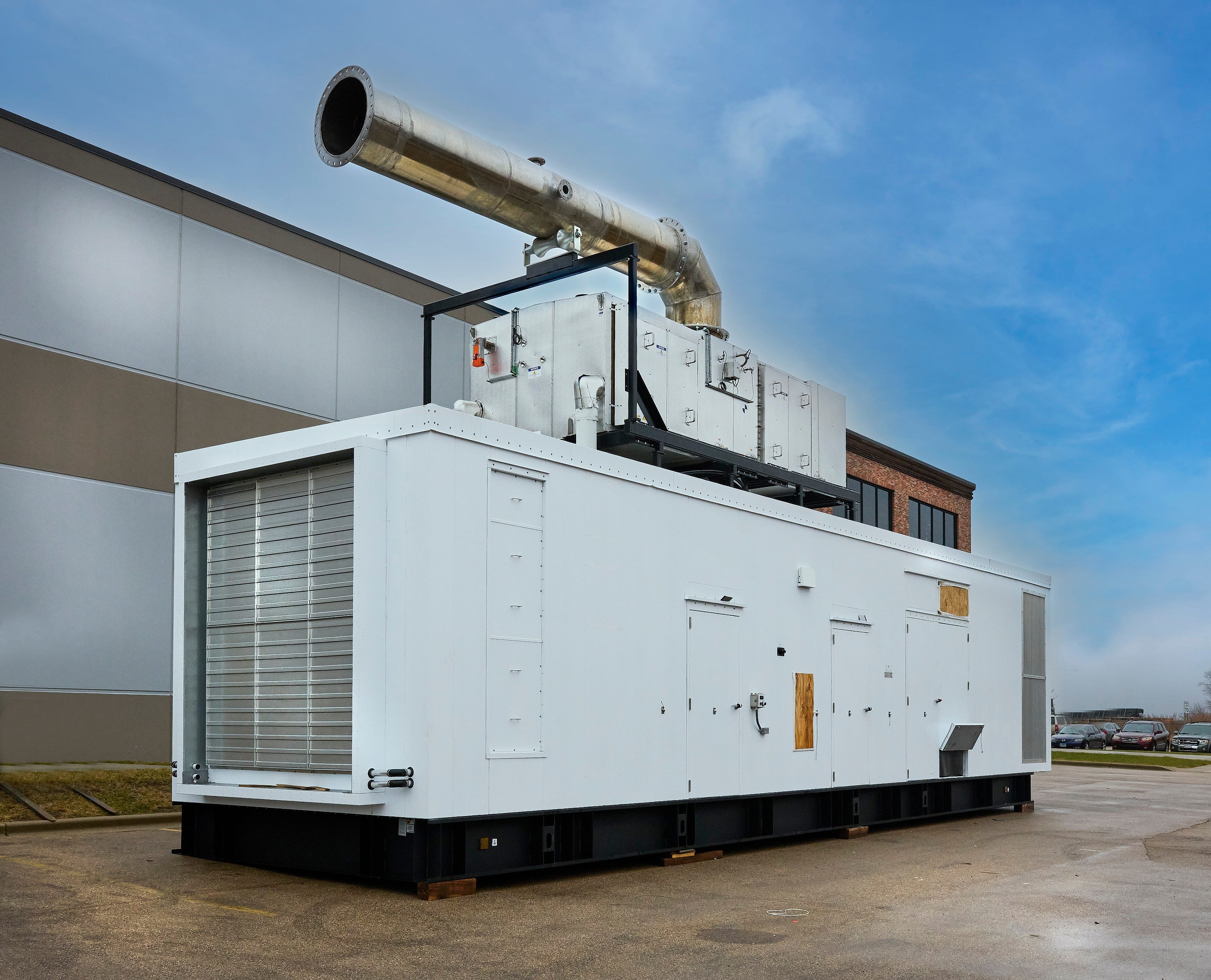
PSIX has historically operated as a highly specialized subcontractor, serving the hyperscale data center market through OEM dealers by integrating gensets into massive, bespoke structural enclosures built to rigorous data-center client specifications, which typically include structural fuel tanks, acoustic paneling, and complex switchgear.
However, listen to any Caterpillar or Cummins investor call, and one can appreciate the current multi-year genset backlogs. This has provided significant opportunity for new market entrants. In April 2025, GNRC 0.00%↑ announced its partnership with Baudouin7. Most recently, this led to Generac announcing an $8bn contract with Amazon to supply backup generators, with $2.4 billion to be delivered in 2027 and 2028.8
As a partner to Generac, we believe PSIX will likely benefit from growing demand for its services, but more importantly, this is a strong testament to the quality of Weichai’s products: if it is good enough for AWS, it is good enough for any American data center.
However, the best is yet to come. As highlighted above, Weichai has always had grand ambitions; servicing the backup power market is just the Trojan horse, and competing head-to-head in gas prime power is what will define its success over the next decade.
Weichai is currently undergoing certification in North America for its natural gas prime power product range, with the natural gas (NG) variant of its popular 12M55 engine already appearing in UL certification documentation9 alongside its datasheets10.
Industry research from Semianalysis recently highlighted “Both Anthropic and Meta have signed 300-500MW deals with Enchanted Rock, a supplier of 0.5MW gensets built around a 21.9-liter V12 gas engine” (link). Public documents show PSIX is closely associated with Enchanted Rock and can supply the exact 21.9-liter natural gas engines to Enchanted Rock, per its historical public press releases.11 We believe Anthropic and Meta will find Weichai/PSIX larger natural gas solutions to be far more attractive than a 0.5MW solution.
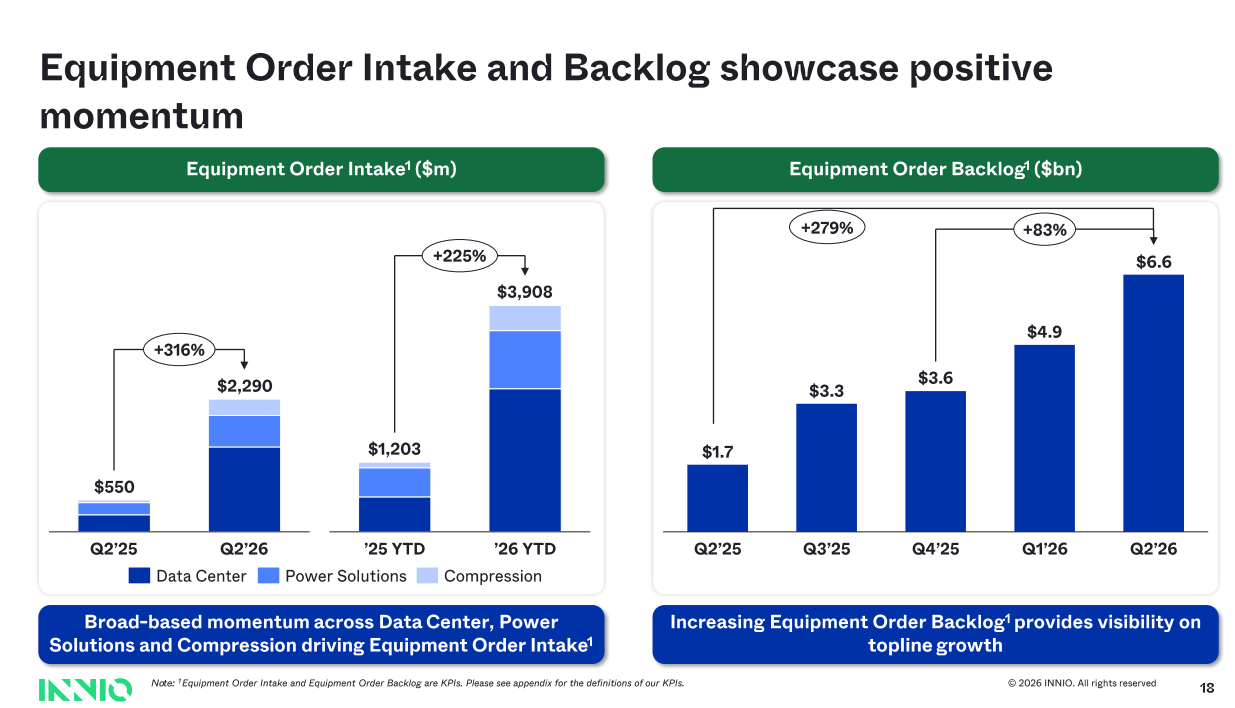
Further, channel checks suggest Weichai’s gas solution will be extremely cost-competitive relative to peers who are now charging in excess of $1m+/MW. INIO 0.00%↑ recent IPO shows how data center revenue can ramp from near zero to multi-billion over a short timeframe, and we believe Weichai’s gas products will most closely resemble this trajectory once approvals are achieved, with PSIX, one of many Weichai-associated entities, as a disproportionate beneficiary.
The End Game
While the economics currently favor selling imported reciprocating engines into America despite heavy tariffs, Weichai has reduced its holding in PSIX in 2025, calling into question its long-term commitment to the business, given it also owns other American entities.
We believe Weichai is heavily incentivized to support PSIX’s long-term success; A key left-tail risk remains surrounding regulation, including the implementation details of the recently introduced Executive Order 14420.12 Therefore, the most sustainable long-term solution is to establish onshore American manufacturing.
In that scenario, the entity would not only need an American manufacturing base but would likely also need to meet FEOC requirements to receive any potential tax credit benefit, putting PSIX at a particularly important juncture: a Chinese-associated entity with a predominantly American investor base.
This could be an extremely powerful combination if Weichai decides to bring its fuel cell manufacturing capabilities to North America and challenge $BE; however, that is another story for another day.
Valuation
PSIX currently trades at around ~10x our FY26 earnings, a level not too dissimilar to when we first identified the opportunity in late 2024; this is despite the execution story having been substantially de-risked since, therefore, to quote our previous 2024 report, “With significant upside potential, the stock could be a multi-bagger within the coming years”.
https://www.engineering.org.cn/sscae/EN/10.15302/J-SSCAE-2019.03.008
https://www.prnewswire.com/news-releases/two-decades-post-ipo-weichai-powers-market-value-soars-30-fold-distributing-rmb-28-billion-in-dividends-302099670.html
https://www.hkexnews.hk/listedco/listconews/sehk/2009/0222/ltn20090222021.pdf
https://www.registre-dematerialise.fr/7383/download/component/149425/compte-rendu-de-reunion-publique-du-30-juin-2026
https://www.sec.gov/Archives/edgar/data/1137091/000119312517127540/d345752d8k.htm
https://investors.psiengines.com/node/13126/pdf
https://www.prnewswire.com/news-releases/generac-strengthens-its-energy-portfolio-with-new-products-designed-for-the-data-center-market-302422605.html
https://investors.generac.com/static-files/7fd7f15a-24c2-4822-b08b-9a2b3319dab6
https://productiq.ulprospector.com/en/profile/8091989/ftsr7.au6636?term=FTSR7&page=2
https://baudouin.com/engine_product-category/powerkit-lean-burn-gas-engines/
https://investors.psiengines.com/news-releases/news-release-details/power-solutions-international-celebrates-shipment-1000th-power
https://www.dwt.com/blogs/energy--environmental-law-blog/2026/08/eo-14420-bulk-power-system-equipment
PSIX seems to have gotten some really bad rep from IR (or lack of) and its price action. interesting writeup!